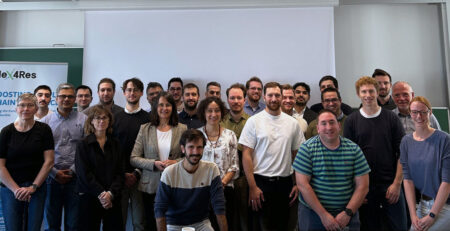
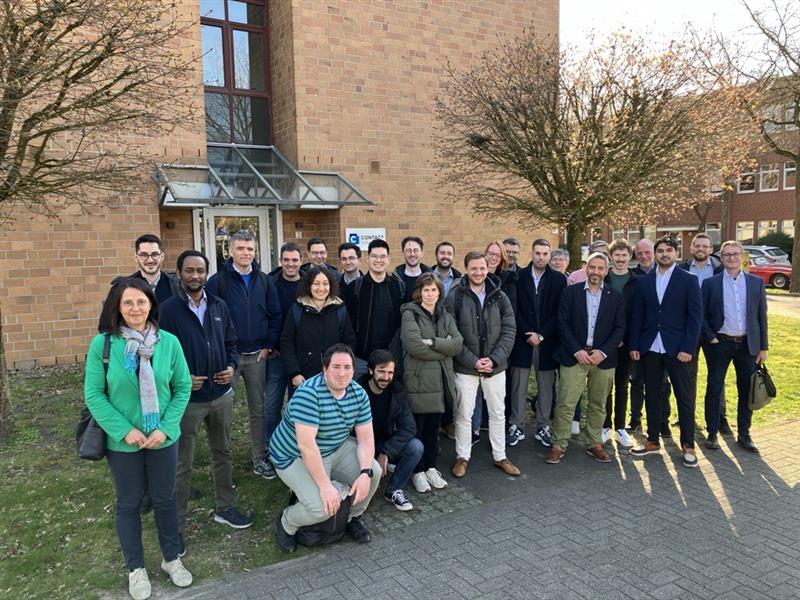
Project meeting in Bremen, Germany
Bremen set the tone for the two-day Flex4Res meeting: a city where advanced manufacturing, logistics and trade meet a vibrant digital ecosystem and a strong research base. The mix of industry depth plus research agility framed discussions about building resilient, reconfigurable production and supply chains during the sixth Flex4Res Project General Assembly in April 2025, hosted by CONTACT Software.
Building an open framework
A central theme of the meeting was the development of an open framework based on data spaces and Asset Administration Shells (AAS). The goal: secure and interoperable data sharing across manufacturing value chains. The Pontus-X federated catalogue is already available, and final versions of AAS models are now in place, with pilot instantiations underway. Another milestone is the definition of AAS-based digital twins for resources, processes and products, which will then be linked across company boundaries to create supply chain twins.
Measuring resilience
The project partners also presented the resilience assessment toolbox, designed to evaluate resilience on three levels: machinery and device (micro), production line and system (meso) and entire supply chains (macro). The toolbox combines a dedicated data model, software services and sensor inputs. Results to date include a resilience data model, assessment tools for factories and supply chains, shopfloor and resource-level tools and a GUI. Methods range from Severity of Failure assessments to Bayesian networks for resilience scoring and fuzzy case-based reasoning for fault detection and human assistance.
Decision-making for reconfiguration strategies
To turn insights into action, the project team is developing a decision-making toolbox that suggests reconfiguration strategies across all three manufacturing levels. This toolbox will build on the results of resilience assessments and data spaces to support timely and well-informed reconfiguration actions.
Testing in real factories
In January 2025, PTW ran a full production day in their FlowFactory to capture data from sawing operations and track disturbances. Insights from this production day, together with the learnings from the pre-pilots, are guiding the implementation in the four use cases:
- voestalpine: Linking assets with scheduling tools via IoT connectors.
- Sidenor: Testing resilience planning at supply chain and factory level, supported by software for planning, scheduling and real-time guidance.
- GOIMEK: Predicting risks in machining, creating machine “fingerprints” and detecting anomalies, with integration into Pontus-X.
- Hans Berg: Exploring smart decision-making tools and human assistance systems for reconfiguring tooling.
Ready for the last mile
The discussions and demonstrations in Bremen highlighted the tangible progress of Flex4Res. From working connectors and AAS submodels definitions to multi-level resilience tools and concrete industrial demos, the project partners have moved firmly from concepts toward implementation. With industrial pilots ready for deployment and testing, the project is now well-positioned to validate how data spaces, AAS and resilience-driven decision-making can make manufacturing systems more adaptive, reconfigurable and therefore robust.