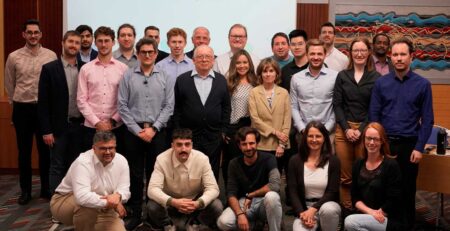
Project meeting in Vienna, Austria
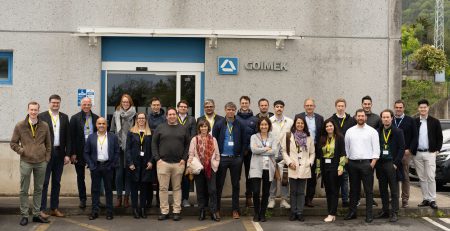
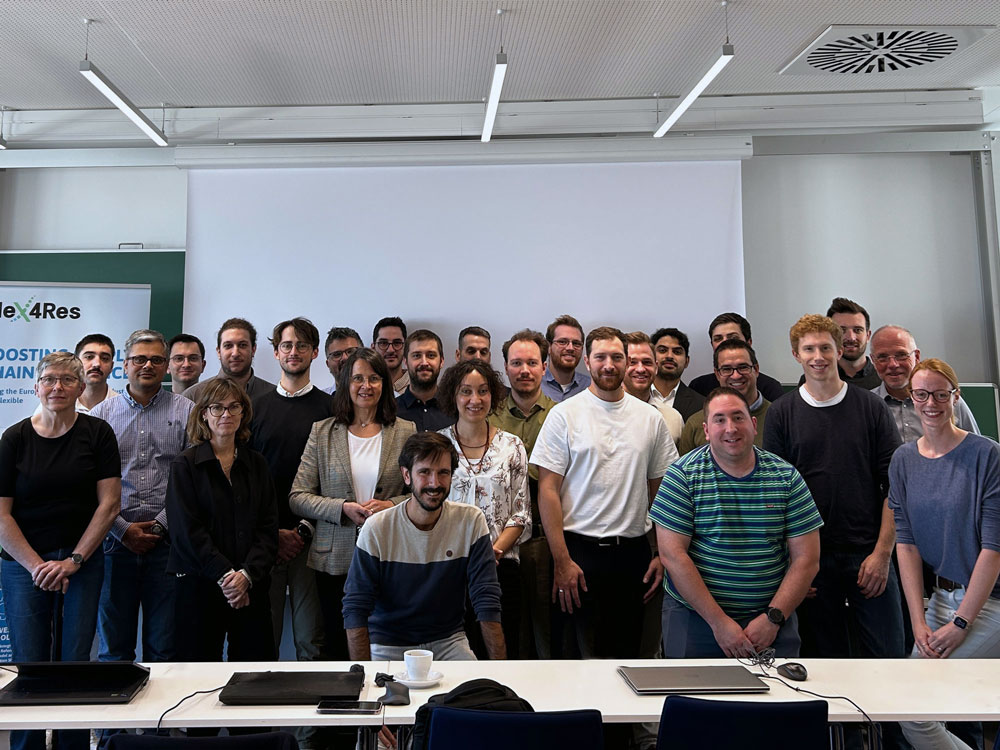
The Institute for Production Engineering and Photonic Technologies (Institut für Fertigungstechnik und Photonische Technologien – IFT) at Technische Universität Wien hosted the fifth Flex4Res Project General Assembly, which took place in Vienna, Austria, on 14 and 15 October 2024. 30 representatives from the 17 partner organisations participated in the project meeting in person.
From workshops to lab tours
Flex4Res is about to enter the final year of its three-year journey, making this the perfect moment to exchange updates, evaluate progress and define the next steps for the last mile. The two-day meeting began with an interactive workshop on the Asset Administration Shell submodels for the pilot cases and concluded with a tour of the impressive TEC-Lab Laboratory for Production Engineering. There, partners had the opportunity to experience the state-of-the-art research infrastructure in the fields of automation and process optimisation first-hand.
Set-up, demonstration and system validation in real industrial cases
In the current phase of the project, the developed tools are being set-up and validated in the partner’s learning factory environments, which simulate real industrial conditions to ensure measurable benefits.
These demonstrations verify end-to-end workflows – from early fault detection and operator guidance to dynamic scheduling and master production planning. Insights from each pre-pilot feed back into iterative refinements, ensuring the solutions are robust, interoperable and ready for the implementation at the use case owner’s facilities: Hans Berg, GOIMEK, voestalpine and Sidenor.
Progress in reconfiguration strategies
One of the solutions under development is the reconfiguration planning toolbox, which helps companies manage production changes quickly and efficiently when disruptions occur. Covering all levels of manufacturing systems, it integrates fault detection and operator guidance at the micro level, dynamic online scheduling for the mid- to short-term production planning at the meso level, and decision-support for manufacturers addressing master production scheduling challenges at the macro level.
Work in this area focuses on developing AI-based strategies for workstation adjustments, optimisation tools for value chain reconfiguration and methods for managing multi-stage production steps.
The toolbox consists of several modules, including a master production scheduler, scheduling and transition tools and human-centric shopfloor support systems, all aimed at ensuring minimal downtime and maximum efficiency.
What’s next?
Looking ahead, the project partners will focus on deploying and testing the developed solutions within the four pilot use cases. The coming months will be dedicated to validating the solutions in real industrial environments, refining their functionality and demonstrating their impact on resilience and flexibility.