Project meeting in Siegen, Germany
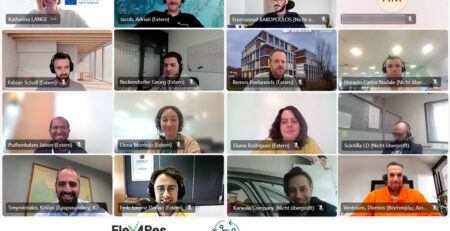
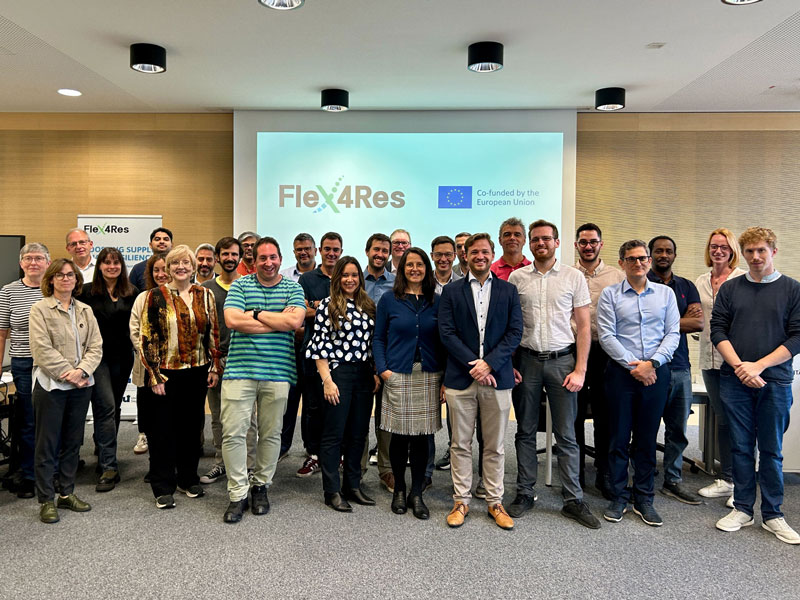
On 8 and 9 September 2025, the Flex4Res project partners gathered at the University of Siegen for its last project meeting. A milestone event that marked the successful completion of several key work packages and demonstrated the project’s continued progress towards resilient, data-driven manufacturing.
Advancing towards resilient manufacturing
Hosted by University of Siegen, a young and dynamic research university known for its interdisciplinary orientation in both research and instruction, the meeting brought together project partners from across Europe. The discussions were enriced by the participation of Jill Urbanic, Flex4Res supervisory board member from the University of Windsor (Canada), who provided valuable international insights into the project’s strategic direction and feedback on the results.
From testing to real-world application
One focus of the meeting was on testing and validation of the solutions developed. Partners discussed pre-installation and testing in learning factory environments, as well as the development of upskilling materials that will soon be made publicly available on the Flex4Res website to support broader adoption of the project’s resilience tools.
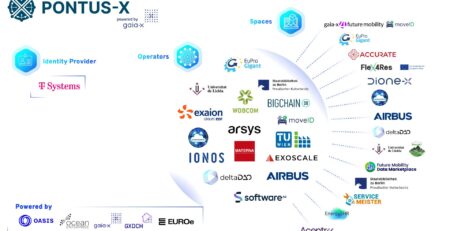
The consortium also reviewed the progress of several pre-pilots that serve as early validation stages for the full-scale industrial pilots. At TU Darmstadt’s PTW, the team developed a Value Stream Resilience Maturity Model – an assessment framework that identifies common disruption types and evaluates resilience across four capability and five maturity levels. LMS and Sidenor successfully validated their infrastructure and services through federated data spaces (IDS and Pontus-X), using synthetic data to simulate real-world disruptions. IFT and voestalpine integrated sensors into bandsaws and connected them to the CONTACT Elements 4IoT platform. Meanwhile, Uni Siegen and Hans Berg demonstrated strong progress in embedding sensors and optical fibres within sheet metal for intelligent tooling, reporting high efficiency, robust technical performance and strong user acceptance. Finally, IDEKO and GOIMEK tested their predictive maintenance and process-monitoring solutions at the Digital Grinding Hub, targeting a significant reduction in reconfiguration time.
Exploring innovation at the University of Siegen
Beyond the technical sessions, partners had the opportunity to explore the ProTech Institute for Production Technology. The institite brings together four chairs, uniting teaching with both fundamental and applied research. The FAMS research group (Production Automation and Assembly), in particular, focuses on agile and sustainable production planning, collaborative robotics and additive manfacturing of sensor-integrated smart tools.
During a guided tour, participants visited the labs of FAMS and UTS (Forming Technology), where they ovserved demonstrations like including optical sensors embedded into metal sheets and a human-assistance system using smart glasses and wearable devices. These innovations exemplify how research at University of Siegen contributes to the goal of Flex4Res.
Looking ahead
The two-day meeting at the University of Siegen underlined the significant technical progress and collaborative spirit driving the Flex4Res project. With multiple work packages successfully concluded, robust pilot testing underway and standardisation work progressing, Flex4Res is well on track to deliver its vision of an open, reconfigurable and resilient manufacturing ecosystem.
As the project enters its final phase, the focus now turns to validating solutions in industrial environments, fine-tuning interoperability within data spaces and preparing the rollout of the resilience toolbox and training materials to the broader European manufacturing community.