ACCURATE
Level up resilience in European manufacturing with a digital-twin-based decision support system operating in a Manufacturing as a Service framework
The ACCURATE project aims to boost the resilience of EU manufacturers in our current so-called Brittle, Anxious, Non-linear, and Incomprehensible (BANI) world with the focus on the aerospace, automotive and electronics industries. By developing digital-twin-based simulations, stress-testing scenarios, and implementing the Manufacturing as a Service (MaaS) paradigm, the project addresses abnormal operating conditions ranging from short-term issues, such as material shortages, to long-term crises, including climate change and geopolitical instability. Additionally, it considers manufacturers’ competitiveness under normal operating conditions.
The approach
- Digital twin for supply chain stress testing
- The project employs AnyLogic and AnyLogistix tools to model the supply chain and integrate these models into a low data latency architecture. This approach allows users to simulate supply chain disruptions, evaluate ripple effects, and make better-informed decisions on adaptation strategies.
- Tailored solutions for the industry
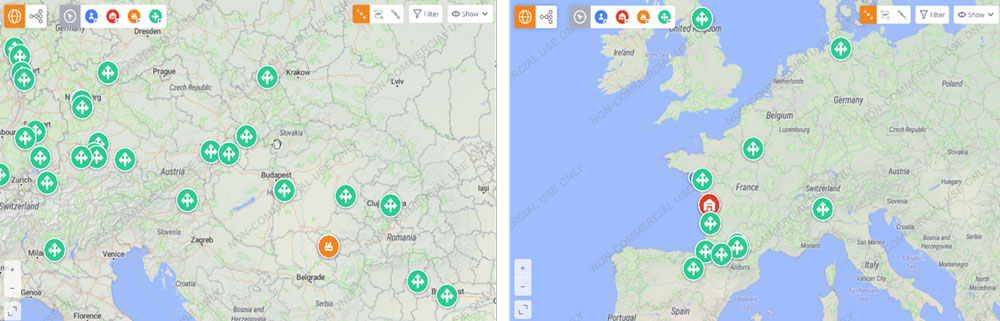
- Airbus Atlantic: The simulation model comprises over 800 parts across three material levels. Efforts also focus on connecting the tier-1 and deep-tier supplier networks, offering insights into unknown risks.
- Continental: A make-to-stock supply chain model captures over 300 electronic and 60 mechanical components from 60 global suppliers.
- Tronico: A two-layer simulation includes the shopfloor layer and internal supply chain levels, addressing high-mix, low-volume production for 20 products across four business segments.
- Disruption scenario development and decision support
- Stress tests are developed using disruptions scenarios such as supplier disruption, material shortages, and crises like the COVID-19 pandemic. The experiment interface will be designed to cover various disruption lengths, locations, and materials, allowing users to tailor experiments to their needs.
- Integrated decision-support systems enable end-users to monitor disruptions, diagnose performance impacts, and make informed decisions under pressure. The approach also facilitates the implementation and adoption of the MaaS paradigm.
- Pilot projects across diverse sectors
- During the latter half of the project, solutions will be piloted together with industry partners. These diverse use cases are expected to make significant contributions to the resilience of EU manufacturing.
- Traditional disruption mitigation strategies, including redundancy, diversity, flexibility, and agility, will be implemented in the second half of the project within the pilot cases. These strategies will be assessed for feasibility and relevance in terms of cost and resilience when applied individually at the manufacturer level.
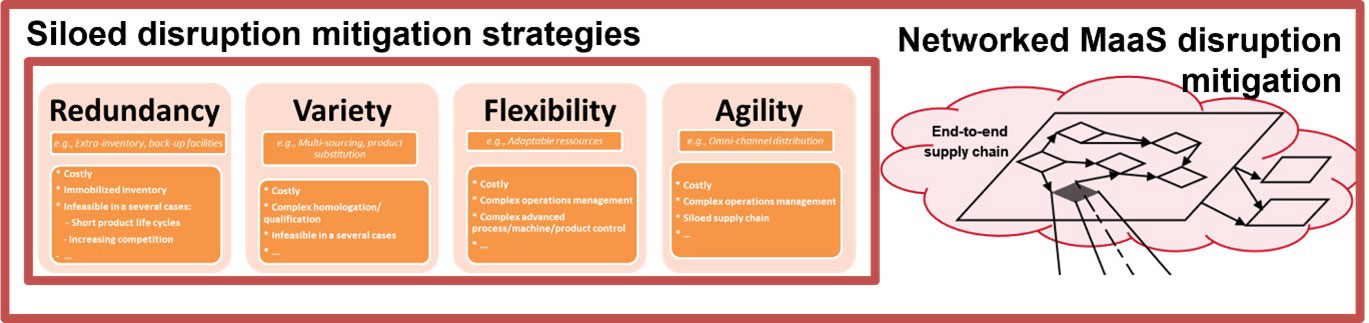

Beyond these traditional approaches, the project leverages the horizontal and vertical decision-making connectivity enabled by digital twins within a MaaS framework. This connectivity supports
- the swift adaptation and reconfiguration of supply chains in response to disruptions or in pursuit of cost and environmental benefits,
- the sharing of manufacturing resources as services at the network level to ensure that local needs – otherwise unfeasible or uncompetitive for individual supply chain stakeholders – are addressed efficiently and consistently.
Visit the website of ACCURATE to learn more about the project: https://accurateproject.eu/